Optimizing the Financial Close: A Fresh Approach to Journal Entry Automation
Centralize workflows, reduce risk, and enable Agentic Financial Operations by automating the manual middle of your Record-to-Report (R2R) process.

Table of Contents
- The Challenge: The Hidden Costs of the Manual Middle
- The Solution: Purpose-Built Automation and AI
- Key Capabilities
- Proven Customer Results
- Quick Facts
Share this Ebook


BlackLine transforms the journal entry process from a manual, error-prone burden into a continuous, automated workflow. By centralizing the entire journal entry lifecycle, BlackLine bridges the gap between your disparate source systems and your ERP environment, offering seamless multi-ERP two-way integration, streamlined journal calculation and preparation, crucial pre-posting validation with underlying ERPs, rigorous preparer and reviewer controls, automated posting, and a complete audit trail.
And journals integration with BlackLine’s broader solutions across Record-to-Report enables the streamlined creation of journals during the substantiation process, like automating drafting a journal based on bank fees, and the attachment of posted journals and related documentation directly to a corresponding account reconciliation.
At the core of this transformation is BlackLine Verity™, our proprietary AI built specifically for finance and accounting. Verity enables Agentic Financial Operations—a modern environment where intelligent, AI-driven agents handle routine, high-volume transactional work throughout the accounting period. Specifically for the journals process:
Verity Accruals collaborates with F&A teams to facilitate the calculation, analysis, outreach, and drafting of an accruals entry.
Journals Risk Analyzer (JRA) performs proactive risk analysis by evaluating the entire population of journals posted across an organization's ERPs, identifying anomalies and risks that require human review in real-time, rather than waiting for the end of the close cycle.
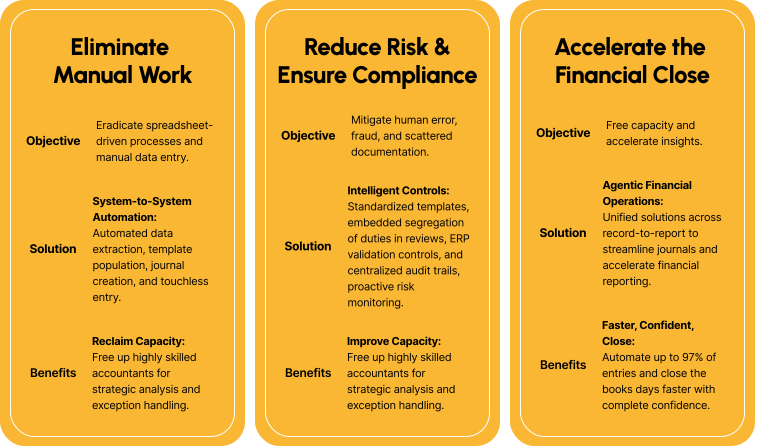
By shifting to a streamlined and automated journals management model, organizations eliminate the month-end crunch. The finance team is empowered to step away from data aggregation and focus entirely on exception handling, accelerating financial analysis, and providing strategic impact to business leaders.
Key Capabilities
Process Rigor & Governance Standardize and drive governance of the journals process end-to-end—from preparing an entry to review, validation, posting, and auditing. BlackLine integrates with broader R2R solutions, allowing journals to be initiated directly from other workflows. Once posted, a full audit trail is maintained, and journals can be attached directly to an account reconciliation, creating a secure, closed-loop process.
System-to-System Automation & Multi-ERP Interoperability Replace manual data pulls and spreadsheet manipulation. BlackLine provides seamless interoperability within a multi-ERP environment, establishing two-way connectivity to pull data and post journals directly to one or more ERPs. It automatically extracts data directly from external source systems, populates standardized journal entry templates, and executes complex cross-charges or allocations (such as corporate overhead or IT expenses) based on your organization's predefined rules.
Touchless Processing for Routine Entries Transition from a multi-step manual process to a fully automated, touchless workflow for low-risk, repetitive transactions. BlackLine can automatically prepare, validate, and post entries, such as those for daily cash settlements from banks and credit card companies, immaterial variances, bank fees, and complex intercompany transactions across multiple entities.
Intelligent Controls, Validation & Embedded Audit Readiness Reduce risk by embedding your specific business rules and segregation of duties directly into the workflow. Automated routing ensures that entries are reviewed by the right personnel. Crucially, BlackLine utilizes pre-posting validation controls to ensure journal information matches the ERP's account string mapping. This guarantees that entries sent to the ERP are posted successfully without bouncing back, ensuring trust and accuracy across all ERPs at once. Furthermore, BlackLine creates a centralized, unalterable audit trail where all supporting documentation is automatically attached to the specific journal entry.
AI-Powered Risk Monitoring & Analysis Move from reactive corrections to proactive risk mitigation. Journals Risk Analyzer (JRA) proactively identifies anomalies, trends, and high-risk entries during the close process. Users gain a real-time view of journals posted across their ERP landscape to quickly identify risk, diagnose breakdowns, and take action on them before they become end-of-cycle bottlenecks.
Organizations leveraging BlackLine's journals solutions are eliminating manual and time-heavy workflows, reclaiming thousands of hours, and realizing immediate efficiency gains.

Measurable Impact
Customer Results
Quick Facts