The Future of Retail F&A: A Blueprint for Agile and Agentic Financial Operations

Table of Contents
- The Macro Forces Reshaping Retail F&A
- The Human and Operational Cost of Manual F&A Processes
- Deconstructing the Retail Transaction Complexity
- Where Margin Slips: Inventory and Supply Chain Friction
- Managing the Physical Footprint: Lease Accounting and Real Estate
- The Intercompany Ecosystem: Franchises, Subsidiaries, and Global Expansion
- Navigating the Solution Landscape: Essential Capabilities for Retail Transformation
- Transforming Retail Workflows with Artificial In telligence
- The Future of Retail Finance & Accounting: The Shift to Intelligent Automation
- The Measurable Impact of BlackLine
- Conclusion: Your Blueprint for the Future
Share this Ebook


The Macro Forces Reshaping Retail F&A
The retail industry does not stand still. Driven by evolving consumer expectations, supply chain volatility, and fierce competition, retail business models are transforming at breakneck speed. However, while the front-end customer experience has been digitized and optimized, F&A teams of many retailers remain trapped in the past.
Today, the retail ecosystem is being fundamentally rewired by several converging macro trends—each of which introduces exponential complexity to the accounting lifecycle:
The Omnichannel & Alternative Payment Explosion: Customers no longer just swipe a credit card at a register. They use Buy Now, Pay Later (BNPL) services, digital wallets, and loyalty points, often buying online and returning in-store. A single transaction that used to require a simple one-to-one match now splinters into three or four reconciliation points across disparate gateways.
Retail Media Networks & Social Commerce: Retailers are monetizing their first-party data by launching advertising platforms, adding entirely new B2B revenue streams (and complex billing/deduction scenarios) on top of their core DTC operations.
Portfolio Reshaping & M&A: Retailers are aggressively acquiring niche brands to capture new demographics. For the Office of the CFO, every acquisition means inheriting a new legacy ERP, a different point-of-sale (POS) system, and a unique chart of accounts that must be rapidly integrated.
To navigate this volatility, agility is non-negotiable. Research from JRG Partners shows that US retailers allocating more than 50% of their annual CAPEX budget to digital initiatives are 1.5 times more likely to achieve above-average revenue growth compared to their peers. Yet, true digital transformation cannot happen if the finance team is anchored to legacy spreadsheets.
When retail business models evolve, but accounting technology does not, the burden falls on the human workforce. The typical retail IT landscape is highly fragmented. Data is siloed across procurement, HR, custom POS systems, and multiple ERPs.
When accountants are forced to act as human middleware between these systems, the entire organization stalls. This pain manifests differently across the F&A leadership spectrum:
The Chief Accounting Officer (CAO) & Controller
The Pain: The CAO is hyper-focused on preventing a material weakness or significant deficiency in financial controls. They face immense pressure from the CFO and board for a faster, more accurate close, but are hamstrung by the "last mile" of the close, a chaotic process of top-side adjustments and manual journal entries.
The Blind Spot: They lack trust in the numbers rolling up from day-to-day operations, forcing their teams to spend excessive time re-validating transactional work rather than analyzing margin impacts.
The Director of Store Accounting
The Pain: This leader manages the accounting integrity of the physical fleet. They are overwhelmed with the immense compliance burden of lease accounting, managing property taxes, and reconciling daily sales and cash deposits from hundreds of stores using disparate POS systems.
The Blind Spot: They rely on manual, error-prone processes to reconcile physical inventory counts between stores and the central ERP, leaving the company blind to shrinkage or in-transit discrepancies until period-end.
The Revenue & AR Accounting Teams
The Pain: Tasked with protecting the top line, these managers face the potential of significant revenue leakage from a complex web of B2B deductions, trade promotions, unmanaged chargebacks, and credit card processor fees.
The Blind Spot: They struggle to reconcile gross sales data from disparate channels with cash received, leading to high Days Sales Outstanding (DSO) and a lack of clear visibility into the true cost of revenue dilution.
Deconstructing the Retail Transaction Complexity
While "omnichannel commerce" is celebrated by marketing, it creates a tidal wave of backend complexity for the Office of the CFO. Every consumer touchpoint generates micro-transactions, varying fees, and deferred revenue that simply break traditional, manual accounting models.
This complexity is driven by modern consumer expectations that blur the lines between physical, digital, and social commerce. For the accounting team, this means reconciling highly convoluted transaction lifecycles, such as:
Buy Online, Return In-Store (BORIS): A sale originates on Shopify via a digital wallet, but is refunded days later at a physical POS terminal, creating a messy cross-system reconciliation challenge and inventory adjustments.
Buy Now, Pay Later (BNPL): The customer receives the product immediately, but the retailer must reconcile fractional payments, deferred revenue, and unique settlement fees from third-party providers like Klarna or Affirm over several months.
Social Commerce & Influencer Impacts: A single viral TikTok post can trigger a massive spike in micro-transactions, requiring finance to instantly reconcile sales data against dynamic influencer commission payouts and affiliate discount codes.
The POS Puzzle: Multiple Payment Providers
Retail isn't just simple e-commerce; it’s the chaotic intersection of digital and physical sales. Consider a single brick-and-mortar point-of-sale (POS) transaction: A customer pays for a $200 purchase using a $100 physical gift card, $50 via Apple Pay, and $50 on a Visa credit card.
Accounting must reconcile the POS system against the gift card liability subledger, the digital wallet settlement, and the merchant processor statement.
Each provider dictates different fee structures, settlement timelines (T+1 vs. T+3), and unstructured file formats.
Multiply this by thousands of stores and dozens of payment providers (Stripe, PayPal, Klarna). Attempting to reconcile this using manual VLOOKUPs or legacy ERP rules inevitably leads to massive backlogs and delayed cash visibility.
The Hidden Cost: Revenue Leakage (Gross-to-Net)
When lean teams are drowning in daily transaction matching, they lose the capacity to analyze
gross-to-net revenue dilution, creating a critical vulnerability for the CFO.
In retail, gross sales rarely equal net realized revenue. Manual processes leave retailers exposed to significant leakage across both Direct-to-Consumer (D2C) and Wholesale (B2B) channels:
Returns & Chargebacks: Failing to quickly identify and dispute credit card chargebacks or fraudulent returns directly erodes the bottom line.
Interchange Fees: An inability to verify if payment processors are applying the correct, negotiated fees across millions of micro-transactions.
B2B Trade Deductions: In wholesale, retailers absorb massive losses if cash application teams cannot automatically isolate invalid trade promotions, shortages, and pricing disputes.
Without automation to handle the transactional heavy lifting, F&A teams cannot protect thin margins—they are left reacting to revenue leakage months after the fact instead of stopping it in real time.
Beyond point-of-sale transactions, the movement of physical goods represents one of the most operationally intensive areas of retail F&A. The rise of "ship-from-store" models, drop-shipping, and global sourcing has shattered the traditional linear supply chain.
In-Transit and Landed Costs: Tracking inventory as it moves from overseas manufacturers to regional distribution centers and finally to stores requires complex capitalization of freight, duties, and handling fees. Manual calculations often lead to inaccurate Cost of Goods Sold (COGS) and skewed gross margin reporting.
The Three-Way Match Disconnect: Reconciling Purchase Orders to Goods Receipts and Vendor Invoices is fraught with discrepancies—pricing mismatches, damaged goods, or partial shipments. When accountants manually investigate these variances, vendor payments are delayed, and early-pay discounts are lost.
Shrinkage and Valuation: Physical inventory counts rarely match ERP records perfectly due to theft, damage, or administrative errors. Investigating and recording shrink adjustments across thousands of SKUs requires deep transactional visibility that spreadsheets simply cannot provide.
Despite the e-commerce boom, the physical store remains the cornerstone of retail. However,
managing the financial lifecycle of a real estate portfolio is a monumental task under ASC 842 and
IFRS 16 regulations.
Variable Lease Expenses: Retail leases are rarely static. They often include complex, variable components such as percentage rent (tied to store sales performance) and fluctuating Common Area Maintenance (CAM) charges. Reconciling these variable costs against actual landlord invoices is a highly manual, error-prone process.
Store Openings, Closures, and Impairments: The dynamic nature of retail footprints means F&A teams are constantly adjusting Right-of-Use assets and lease liabilities. Opening a new flagship or closing an underperforming location requires rapid, precise journal entries and impairment calculations that disrupt the standard month-end close cycle.
As retailers expand into new geographies or adopt franchise models, they inadvertently weave a highly complex network of intercompany transactions.
Cross-Border Settlements: When a foreign subsidiary purchases inventory centralized by the parent company, it triggers complex cross-currency allocations, transfer pricing markups, and statutory tax reporting requirements.
Franchise Royalties and Co-Op Advertising: Retailers operating franchise models must continuously audit franchisee sales reports to accurately calculate royalty fees and manage shared marketing funds. Dispute resolution between corporate and franchisees often stalls revenue recognition.
The Elimination Bottleneck: At period-end, consolidating these disparate subsidiary ledgers requires netting out thousands of intercompany balances. When these balances don't match due to timing differences or currency fluctuations, the corporate close grinds to a halt while accountants hunt for the discrepancies.
The true power of modern financial technology lies in its ability to execute complex, judgment-based workflows across the entire accounting lifecycle. By deploying intelligent AI, retail finance teams can automate historically manual bottlenecks, freeing capacity for strategic analysis and margin protection.
BlackLine’s approach ensures retailers can realize tangible AI ROI today, while perfectly positioning their teams for a broader, autonomous future.
Available Now: Automating the Month-End Accruals Bottleneck
Accruals for unpaid invoices—ranging from seasonal marketing agency fees, 3PL freight charges, to store utilities—are a massive bottleneck. Traditionally, accountants spend days cross-referencing ERP data and emailing vendors to estimate unbilled expenses.
The AI Solution (Verity Accruals): Available today, AI agents automatically ingest data from P2P systems, proactively email vendors to confirm unbilled services, read the replies to extract financial data, and calculate a proposed accrual based on accounting logic. Finally, the AI drafts a complete, audit-ready journal entry.
The ROI: Retailers utilizing this live solution have reduced the time spent on accruals by 80%, accelerating their overall close by up to three days.
The solution to retail's volume and complexity is Agentic Financial Operations. However, Agentic Financial Operations is not simply about adding "bots" to a broken process. It is a holistic paradigm shift that requires three critical components working in unison: a unified data foundation, robust core applications, and purpose-built artificial intelligence acting as a digital workforce.
F&A teams cannot deploy generic Large Language Models (LLMs) to achieve this. In finance, 95% accuracy means 100% failure. F&A professionals are rightfully cautious of the "black box" of generic AI, where data privacy is uncertain, audit trails are non-existent, and hallucinations can lead to material misstatements.
Agentic Financial Operations in Action: Immediate Impact and Future Vision
Agentic Financial Operations extends far beyond the month-end close. By establishing a unified data foundation with BlackLine's core applications today, retail finance teams are perfectly positioned to leverage the next generation of financial technology across the entire financial lifecycle.
BlackLine ensures retailers can deploy tangible AI today while building toward a broader visionary roadmap for both Record-to-Report (R2R) and Invoice-to-Cash (I2C) processes.
BlackLine Verity™: Trustworthy, Auditable AI Powered by a Core Platform
To safely deploy AI, retail organizations need the solid foundation of the BlackLine platform. Solutions like Transaction Matching, Account Reconciliations, and Journal Entry perform the heavy lifting today—standardizing workflows and establishing the deterministic, highly secure control framework required for AI to safely operate. Verity alone cannot perform complex use cases without this application layer.
Sitting on top of these core applications is BlackLine Verity™. Verity provides the essential application and control layer that makes powerful AI auditable, trustworthy, and deterministic for the enterprise. Built on BlackLine’s Studio360 connected data platform, Verity ensures that AI agents operate on a single, clean source of truth, mitigating the "garbage in, garbage out" risk.
To ensure absolute trust, Verity operates on a dual-governance model:
Auditable Agents: AI agents operate within the exact same controls framework as human users. Every action, calculation, and data extraction is fully logged and explainable.
Human Authority and Oversight: Users always retain complete control and final authority over all outputs. The AI proposes and drafts, while the human reviews and approves—freeing up your team to reallocate their time toward value-added strategy and analysis rather than manual data entry.
The Visionary Roadmap to Autonomous Accounting
Because the BlackLine Studio360 platform centralizes your data and standardizes your workflows today, it prepares your F&A team to seamlessly adopt upcoming Verity capabilities as they are released, including:
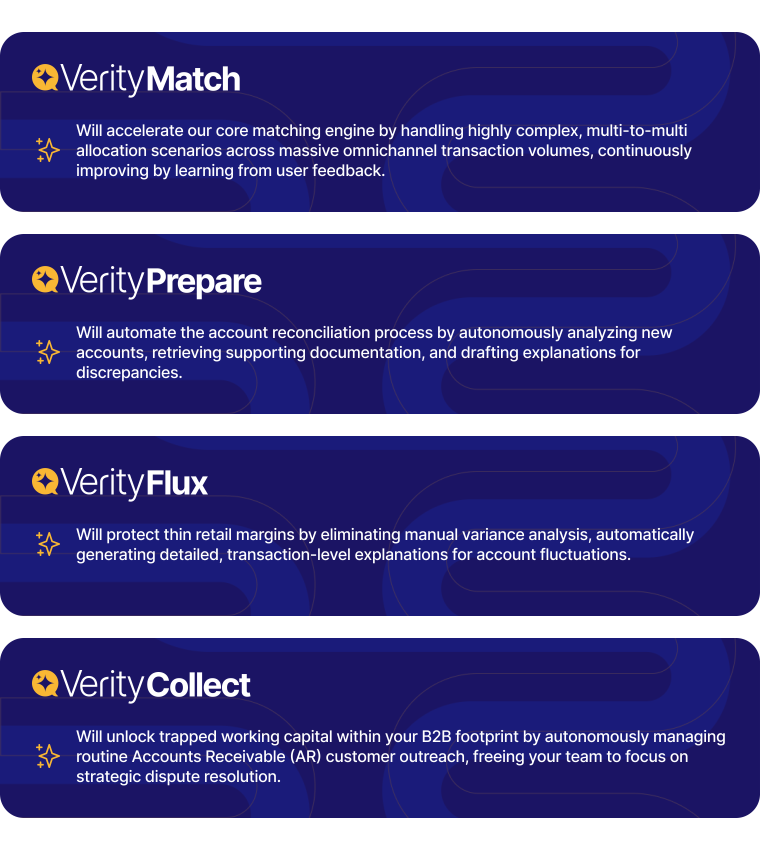
Retail organizations that partner with BlackLine establish a new standard for their financial operations. By transitioning to a state of continuous control, teams shift their focus from manual reconciliation to strategic analysis.
Elevating the F&A Team: Reallocating Time, Not Replacing Talent
The ultimate goal of Agentic Financial Operations is the strategic reallocation of human capital, empowering F&A organizations to seamlessly absorb exploding omnichannel transaction volumes while elevating their talent. By automating the transactional foundation and eliminating the fragmented, spreadsheet-driven processes that stretch teams to their limits, retail accountants are freed from the exhaustion of manual ticking-and-tying.
This shift allows the entire finance team to act as strategic partners to the business. Instead of spending weeks just trying to close the books, they can focus on protecting thin margins from unseen revenue leakage, analyzing pricing strategies, optimizing complex vendor relationships, and instantly tracking vital metrics like Gross Margin Return on Investment (GMROI), Sales per Square Foot, and Sell-Through Rates without waiting for the books to close.
This proven approach to scaling financial operations is exactly why 6 of the top 10 global retailers, alongside industry leaders like Red Wing Shoes, Domino’s, and Aramark, rely on BlackLine to transform their F&A organizations.

The complexities of the retail ecosystem cannot be solved by applying a digital checklist over a broken, manual process. True financial transformation requires an engine that executes the work. The future of retail F&A is built on Agentic Financial Operations. By establishing a scalable foundation of agentic AI and continuous control, you equip your people with the tools they need to evolve from historical scorekeepers to visionary co-pilots, operating with the speed, accuracy, and intelligence required to protect margins and power sustainable retail growth.
Stop manually ticking and tying millions of transactions. Discover how BlackLine and Verity AI can bring Agentic Financial Operations to your retail organization.