Your CFO's Guide to the Augmented and Intelligent Finance Workforce

Table of Contents
- Executive Summary
- The Evolution of Financial Operations
- The Shift to Proactive and Autonomous Finance
- Laying the Foundation: How to Build Agentic Financial Operations
- Challenges and Mitigation Strategies
- Conclusion: Seizing the Proactive Advantage
- Next Steps on the Journey
Share this Ebook


Executive Summary
Rapid advancements in artificial intelligence are redefining corporate finance and accounting, transforming the traditional finance and accounting functions from reactive, historical reporting units into strategic growth drivers. This technical evolution is giving rise to Agentic Financial Operations. Powered by automation and agentic AI, this modern operating model provides continuous visibility, empowering the CFO to make real-time, data-driven decisions.
Developed in partnership between BlackLine and RSM, this strategic briefing defines readiness for the agentic era. Drawing on RSM’s extensive business transformation experience and BlackLine’s leadership in financial close automation technology, this collaborative research emphasizes that success lies in a deep understanding of a company's unique needs and leveraging technology to instill confidence in a world of change. Our analysis centers on how AI agents can augment, rather than replace, human expertise. We define the five critical pillars of this transition: data, technology, people, processes and culture. This framework provides chief financial officers with a practical roadmap to lead their organizations confidently into a proactive, autonomous future.

Rapid advancements in artificial intelligence are redefining finance as a strategic engine that anticipates trends, optimizes operations, and drives corporate direction.
For decades, the office of the CFO focused primarily on record-keeping, compliance, and historical reporting. Their primary function was to ensure accuracy and control, typically operating in a reactive mode. Today, rapid AI advancements are redefining finance as a strategic engine that anticipates trends, optimizes operations and drives corporate direction. This evolution is giving rise to Agentic Financial Operations, establishing the CFO as a strategic copilot who influences enterprise growth.
However, transitioning to this autonomous state is not a simple, plug-and-play upgrade. It requires a significant operational lift. Leaders must commit to the deliberate work of aligning data, workflows and technology to make these systems function effectively. This challenge is underscored by RSM's Middle Market AI Survey 2026, which found that while 86% of organizations have integrated AI into their operations, only 36% have fully embedded it across core business processes. Successfully navigating this complexity requires deploying governed AI agents that work alongside human professionals, with automation acting as an accelerant to human judgment rather than a replacement. ¹
¹ RSM, Middle Market AI Survey July 2026
The Shift to Proactive and Autonomous Finance
The transition to Agentic Financial Operations is often characterized by the rise of the continuous close, touchless operations, and autonomous finance. This shift is driven by an emphasis on greater efficiency, real-time insights and the ability to adapt quickly to market changes. A strategic consulting approach focuses on identifying client-specific pain points to implement tailored solutions that drive intrinsic value and sustainable growth, relying on existing technology platforms to take advantage of embedded AI solutions. To support this effort, advanced Agentic Financial Operations platforms powered by integrated AI allow accounting and finance departments to deploy trusted AI agents directly within their established workflows, achieving rapid modernization and a faster return on investment without disruption. Key platform functionality includes:
Automation of Repetitive Tasks: AI capabilities, particularly agentic AI, enable the delegation of repetitive, high-volume transactional workflows. This includes automating data ingestion, document creation, invoice processing, journal entries, and broad account reconciliations. Strategic advisors actively leverage agentic financial solutions to help organizations streamline these accounting processes and enhance controls, allowing finance professionals to focus on higher-value, strategic work.
Continuous Processes: Finance operations are transitioning from periodic close cycles to a continuous close. Reconciliations and transaction matching occur on an ongoing basis rather than in a rushed month-end window, providing real-time financial accuracy. Advisory collaborations with organizations often involve reimagining workflows for scale and automation, facilitating steady improvement and enabling AI agents to collaborate with finance professionals to operate with greater agility.
Strategic Focus: By offloading routine transactional work to AI agents, finance professionals are freed to concentrate on higher-value activities such as forecasting, scenario planning, risk mitigation, and strategic business partnering. Strategic advisory services are designed to support CFOs in this transition, enabling them and their teams to become more strategic and less transactional, truly embodying the spirit of Agentic Financial Operations.
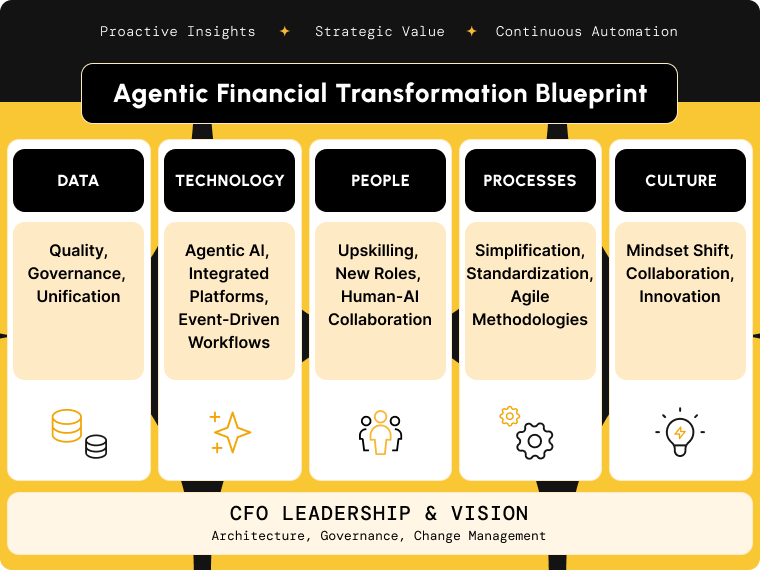
RSM's research and experience in business transformation demonstrates that optimizing support functions like finance is crucial for boosting efficiency, reducing costs and driving business success. Industry insights reveal that integrating best practices in organization design, processes, systems, digital practices and talent development creates the essential foundation required to successfully establish Agentic Financial Operations.
Data as Destiny: Why Your AI-Ready Finance Foundation Starts with Quality
At the heart of any proactive finance function is high-quality, reliable data. AI is only effective if it is built on a foundation of accurate data, making robust data governance and quality control paramount. Gartner research indicates that organizations will abandon 60% of AI projects unsupported by AI-ready data through 2027, illustrating the high stakes of poor data management.² Addressing data quality and integration challenges, often encountered with legacy enterprise resource planning (ERP) systems, requires a disciplined commitment to data cleansing, standardization and a clear architectural roadmap, establishing access to trustworthy insights. A company's AI strategy is only as strong as its data foundation. Critical data efforts include:
Data Quality and Standardization: Fragmented and inconsistent data hinders AI's effectiveness. Organizations must standardize charts of accounts, unify entity mappings and ensure consistent tagging of transactions.
Data Governance: CFOs must lead efforts in establishing strong data governance frameworks to ensure data accuracy, integrity and security across all financial systems.
Unified Data Platforms: Creating a single source of truth for finance and accounting is paramount. This requires building a unified data model that ingests, cleanses and harmonizes data from various ERPs and other third-party systems to ensure accurate, auditable results.
² Gartner, "Lack of AI-Ready Data Puts AI Projects at Risk," February 2025.
A firm's AI strategy is only as strong as its data foundation.
How to Get Started
AI is not a silver bullet and must be deployed in a thoughtful way to unlock success that can be built upon as companies expand their usage of the technology. To effectively identify high-impact use cases and construct a compelling business case for investment, finance leaders should adopt the following proven methodology:
Discover & Assess: Establish a clear baseline of business priorities, operating realities, data landscape and AI readiness so downstream efforts remain focused, practical and value driven.
Outcome Identification: Identify and prioritize desired outcomes for automation that are both high-impact and execution-ready. This structured approach ensures that selected use cases align with ultimate goals, preventing the common pitfall of pursuing AI initiatives with limited return.
Develop Roadmap: Translate prioritized use cases into a pragmatic AI roadmap. A clear roadmap connects strategy to execution and aligns AI investments to be timed, resourced and sequenced to deliver early wins while building sustainable capabilities.
Deploy Pilot AI Use Cases: Prepare selected pilots for execution with clarity and confidence. Many AI pilots fail due to unclear scope and success criteria. This phase helps ensure pilots are execution-ready and positioned to demonstrate tangible value quickly.
Continued Execution: Conclude each opportunity by reviewing its outcomes, documenting lessons learned and providing comprehensive reports to track progress, measure success and inform future decisions.
Beyond Automation: How Agentic AI Unlocks True Financial Agility
Agentic Financial Operations leverage advanced technologies, with agentic AI being a key enabler. AI agents are intelligent, goal-oriented systems that can learn, adapt, and act with minimal oversight. To establish this capability, organizations should invest in scalable, auditable platform architectures that form the technological backbone of modern finance. Key elements include:
Core AI Capabilities: AI in finance drives predictive insights, forecasting, real-time calculations and narrative reporting. These agentic capabilities automate complex processes like account reconciliation, transaction matching and variance analysis. Deploying this advanced intelligence allows organizations to streamline workflows and enhance control, freeing finance professionals to focus on strategic analysis.
Event-Driven Workflow: The power of agentic AI is maximized when integrated within a single point of control where processes, triggers and AI agents collaborate in real time. This orchestration creates an environment where once a task is completed, the next action is triggered automatically, eliminating process latency. Establishing these event-driven workflows creates a cohesive, automated environment where handoffs are instantaneous and secure.
Integrated Platforms: To unlock true financial agility, AI agents must operate within a unified platform rather than disparate point solutions. A unified platform ensures consistent data flows, role-based security and a single, transparent audit trail. Designing and deploying these integrated architectures ensures long-term scalability, data integrity and strict compliance.
Your Greatest Asset: How to Equip Your Team for Agentic Financial Operations
The transition to Agentic Financial Operations reshapes finance roles, demanding new skills and mindsets. Talent development and upskilling are crucial for navigating this changing environment and enabling teams to thrive alongside advanced AI systems. Focus areas include:
Upskilling and Reskilling: Employees need training in AI literacy, data analytics and critical thinking to interpret AI-generated insights and focus on strategic tasks, transforming them into skilled operators of automated workflows.
New Roles: The emergence of roles like data stewards and AI workflow specialists is crucial for managing and monitoring the performance of AI agents. Rather than managing manual data entry, finance leaders will focus on managing and directing these digital assets over time.
Human-AI Collaboration: The future of finance lies in co-execution. AI agents handle repetitive processing while human professionals provide essential oversight, apply qualitative context and deliver strategic guidance. CFOs must balance continuous automation with human control, a balance essential for fostering true operational synergy.
Agile by Design: Why Process Transformation is Key to Unlocking Speed and Efficiency
Achieving Agentic Financial Operations requires a critical review and transformation of existing processes. Success requires identifying and optimizing core finance processes, including record-to-report, procure-to-pay, invoice-to-cash and plan-to-act, enabling teams to operate with maximum velocity and accuracy. Transformation areas include:
Simplification and Standardization: CFOs must challenge legacy processes, eliminating redundancies and streamlining workflows to make them AI-ready. Standardizing processes globally ensures consistency across regions, paving the way for scalable, highly efficient automated operations.
Continuous Improvement: Unlike rigid legacy automation, AI-driven processes learn and adjust dynamically without requiring constant reprogramming. This enables continuous, self-optimizing workflows that adapt seamlessly as data inputs and business conditions change.
Agile Methodologies: Adopting agile approaches to process re-engineering enables finance teams to respond swiftly to changing requirements, deploying improvements and delivering tangible value incrementally rather than waiting for massive, multi-year system overhauls.
The future of finance lies in co-execution. AI agents handle repetitive processing while human professionals provide essential oversight, apply qualitative context, and deliver strategic guidance.
The CFO as Visionary: Cultivating the Leadership and Culture for Proactive Success
A successful Agentic Financial Operations model is underpinned by a supportive organizational culture and strong leadership from the CFO. Real innovation starts with understanding a client's biggest challenges and working together to turn transformational ideas into reality, fostering the collaborative environment needed for Agentic Financial Operations. Crucial considerations include:
Mindset Shift: CFOs must recognize AI as a present-day reality capable of transforming finance and moving beyond traditional views. Navigating this shift positions leaders to adapt to the future and champion their finance teams.
Cross-functional Collaboration: Digital transformation is inherently collaborative, requiring cooperation across finance, IT, operations and other departments to break down silos. Collaborative design sessions and ongoing alignment are crucial for unified operations.
Innovation and Experimentation: Cultivating a culture that embraces experimentation and calculated risks is essential for innovation in an AI-driven environment.
CFO as the Architect: The CFO is uniquely positioned to lead this transformation, establishing the foundation of people, processes, data, governance and controls necessary for success. Designing and implementing future-ready finance operating models develops the capabilities needed to drive strategic advantage.
While the benefits are significant, the journey to Agentic Financial Operations is not without its hurdles. To succeed, organizations must proactively navigate these key challenges with disciplined risk management and strategic foresight.
Cost and ROI: The upfront investment in AI technologies can be substantial, and demonstrating immediate ROI can be challenging.
Strategic Mitigation: Start with targeted pilot projects that have clear, measurable goals to prove value early. Building a robust, value-driven business case demonstrates that technology investments directly support the finance department’s long-term strategic goals and delivers a clear, step-by-step ROI. Understand that not all challenges need to be solved through AI solutions—process re-design, integrations and other automation methods may be more cost-effective than deploying and maintaining an AI solution.
Data Quality and Integration: Poor data quality and difficulties integrating advanced AI tools with legacy ERP systems are common stumbling blocks.
Strategic Mitigation: Commit to thorough data cleansing, standardization and a clear architectural roadmap. Prioritizing robust data governance enables the finance organization to operate with a single, highly reliable source of truth.
Resistance to Change: Fear of job displacement, lack of understanding and cultural inertia can severely impede adoption.
Strategic Mitigation: Embed comprehensive change management, structured training and transparent communication from day one. Actively involve employees in the transformation process to demonstrate how AI acts as an augmentative partner rather than a replacement, building trust and alignment.
AI Bias and Governance: Ensuring ethical AI use, data privacy and compliance with evolving regulations is a critical enterprise risk.
Strategic Mitigation: Establish formal AI governance guidelines and continuous monitoring protocols. Designing rigorous governance frameworks and executing operations within secure, enterprise-grade technology platforms establishes automated financial workflows that remain fully auditable, compliant, and secure.
Agentic Financial Operations is no longer a futuristic concept but a strategic imperative for CFOs aiming to drive sustained growth and a competitive advantage. Navigating this transformation successfully requires a dual-engine approach: aligning deep strategic consulting to prepare the organizational foundation with a purpose-built agentic platform to execute the automation. By meticulously preparing teams across data, technology, people, processes and culture, your organization can establish a collaborative environment where human expertise is elevated by digital capabilities.
This journey demands visionary leadership, a commitment to continuous learning and a willingness to embrace new paradigms. Those who "redefine ready" today, by combining strategic transformation expertise with advanced automation platforms, will lead the finance function of tomorrow, unlocking unparalleled efficiency, deeper insights and greater value for their organizations. Together, RSM’s strategic process advisory and BlackLine's Verity AI, purpose-built for the office of the CFO, deliver the combined proficiency required to successfully execute this vision.
To help assess your readiness and map out an intelligent finance roadmap, RSM and BlackLine offer collaborative strategy frameworks to align your people, processes and technology.
To see these concepts in action, read Part 2 of this series, "The Digital Teammate: A Day in the Life of a Continuous Close," which explores how agentic automation operates on a day-to-day level to achieve a continuous, exception-driven close.