The Diagnosis: Why Traditional Intercompany Fails in a Real-Time World

Table of Contents
- Introduction: The Hidden Drag on Corporate Performance
- The Great Divide (Upstream): Why a Disconnected Close Will Always Be a Broken Close
- Why It Fails: The Anatomy of a Broken Process
- A Cautionary Tale: The Archer Daniels Midland (ADM) Intersegment Accounting Case
- The Mandate for Modernization
Share this Ebook


This paper is the first in a three-part series designed to help finance leaders modernize intercompany accounting from identifying the problem to executing the transformation. Each paper builds on the last, moving from insight to action.
PART ONE. The Diagnosis: Why traditional intercompany processes are fundamentally broken in a real-time finance environment.
PART TWO. The ROI of Intercompany: A look at transforming a hidden cost center into a strategic advantage.
PART THREE. The Blueprint for Transformation: A practical guide to building a modern intercompany operating model.
Why It Fails: The Anatomy of a Broken Process
The dysfunction of traditional intercompany accounting is not a single point of failure. It is a systemic breakdown across three areas:
Fragmented Data & “ERP Spaghetti”
Global companies are rarely built on a single, unified ERP system but instead rely on data from various non-ERP systems that are core to intercompany cost flows. The reality is a complex landscape of dozens of different general ledgers across various subsidiaries, often inherited through mergers, acquisitions, and regional autonomy. This "ERP spaghetti" makes a single source of truth impossible. Data is siloed, formatted inconsistently, and lacks structure and enriched data attributes for different stakeholder groups’ needs. Critical details like invoice numbers, tax codes, or counterparty information are lost in translation between systems. To bridge these gaps, teams create monstrous, multi-tabbed "Frankenstein spreadsheets" that become the unofficial system of record – a brittle, error-prone foundation for a process that demands precision and control. Each manual extraction, copy-paste,
and VLOOKUP is a potential point of failure that corrupts the data before the analysis can even begin.
The "Email Apocalypse" of Manual Processes
The operational backbone of traditional intercompany is the email inbox, or chat channels, insistently pinging. Lacking a centralized platform, finance and shared services teams are forced to perform thousands of hours of low-value, repetitive tasks. The lifecycle of a single dispute is a case study in inefficiency: an initial email is sent, managers are CC'd, the thread is forwarded to different departments in different time zones, and conflicting spreadsheet attachments fly back and forth. This "email apocalypse" extends beyond disputes to core activities like manually keying invoices from PDF scans, performing manual journal entries for reclassifications, and executing cumbersome netting calculations offline. This reliance on manual effort creates a brittle, unscalable process that is profoundly demoralizing for the highly skilled professionals forced to operate it, turning financial analysts into data janitors.
The "Black Box" of Policy, Visibility, and Risk
Perhaps the biggest failure is the complete lack of a centralized, transparent, and enforceable system for governing intercompany transactions. This creates an opaque "black box" where policies can be poorly enforced, special agreements can fester, and a lack of real-time visibility can lead to massive financial and regulatory risk. Problems are often undiscovered until the final, frantic days of the financial close, or worse, during a tax audit.
For many organizations, intercompany challenges surface as delays, discrepancies, or frustrating month-end fire drills. In some cases, the consequences go much further, reaching the highest levels of financial reporting integrity.
The recent case involving Archer Daniels Midland (ADM) offers a powerful example. Over several years, transactions between ADM’s internal business units, particularly within its Nutrition segment, were not just operationally misaligned; they were improperly recorded in a way that helped the business meet its profit targets. What should have been controlled, transparent internal transactions instead became a point of vulnerability.
The issue did not surface during the day-to-day execution of the process. It emerged later under external scrutiny.
In January 2026, ADM agreed to pay a $40 million civil penalty to the U.S. Securities and Exchange Commission (SEC) to settle accounting charges related to these practices. The investigation ultimately revealed that the Nutrition segment’s performance had been materially overstated, leading to a $228 million reduction in reported operating profit over the 2018-2023 period.
This wasn’t simply a case of isolated error. It exposed a broader breakdown in oversight where internal transactions lacked the controls, transparency, and governance required to ensure accurate financial reporting.
The lesson is clear: when intercompany processes operate without centralized control and visibility, they don’t just create inefficiencies; they can create the conditions for material financial misstatement.
And in today’s regulatory environment, those risks rarely stay hidden.
The Mandate for Modernization
The evidence is clear: traditional intercompany accounting is not just inefficient; it is a critical vulnerability at the heart of the modern enterprise.
What was once tolerated as operational complexity has become a direct risk to financial accuracy, compliance, and business performance. The combination of fragmented systems, manual processes, and limited visibility creates an environment where errors persist, issues go undetected, and risk accumulates over time.
In today’s regulatory and economic environment, those risks don’t stay contained.
As the presented case has shown, the consequences of weak intercompany control can scale quickly and lead to significant damage.
This is the reality that many finance leaders are facing today. Continuing with legacy intercompany processes is not a choice; it is an active acceptance of financial risk and inefficiency.
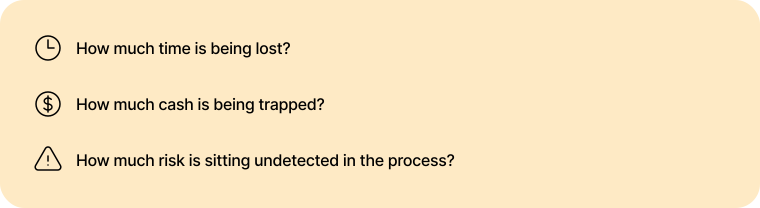
The question is no longer if transformation is needed, but how long organizations are able to afford to operate without it. However, driving meaningful change and understanding the problem is simply not enough. Leaders need to quantify it: