Why Co-Pilots Aren't Enough
The CAO’s Guide to Governed, Agentic Financial Operations.

Table of Contents
- Navigating The AI Crossroads in the CFO’s Office
- The Shortcomings of "Excel-Bound" Co-Pilots
- Why Platform Architecture Matters
- How to Evaluate Finance AI Vendors
- The Comparative Evaluation Grid
- The Shift to Agentic Financial Operations
- The Path Forward to Securing Your Finance Future
- Next Steps
Share this Ebook


Dozens of workplace co-pilots now claim to automate daily corporate tasks. While these tools can save time on administrative tasks, they fall short in the high-stakes, zero-error environment of corporate finance and accounting.
Generic LLMs suffer from a critical context gap. They lack:
- Domain-specific corporate financial context.
- Multi-ERP data structure understanding.
- The explicit accounting business logic required to run complex financial operations.
A generic co-pilot can help write an email or summarize a meeting transcript, but it cannot reconcile millions of transactions across legacy systems.
Furthermore, introducing unmonitored AI tools to unstructured, siloed spreadsheet environments creates serious governance and security risks. Spreadsheets lack audit trails, data integrity controls, and security standards. Feeding spreadsheet data into generic AI models is a compliance risk.
Ultimately, Co-pilots can help you write faster, but they cannot orchestrate a secure, compliant, and auditable financial close.
Why Platform Architecture Matters
To build a reliable AI strategy, CAOs must prioritize platform architecture over fragmented tools.
Point Solutions vs. Unified Platforms
The market is filled with niche accounting AI startups. Relying on these disparate point solutions leads to tool fatigue and integration challenges. Each point solution creates a new data silo, increasing the risk of data leakage and synchronization errors.
The Multi-ERP Imperative
Your AI is only as good as the data it accesses. Modern enterprise finance departments operate across multiple ERP systems. True financial AI requires agnostic, multi-ERP harmonization to feed accurate, standardized data into frontier AI models.
Creating a Single Source of Truth
A unified platform architecture acts as a cleansing and standardizing layer. It organizes and validates your financial data before any automation is applied. This ensures that the inputs are reliable and the outputs are accurate, secure, and consistently reproducible.
Ask prospective vendors the following critical questions:
- How is the AI trained? Does it rely on public web data, or is it trained on deep, domain-specific financial context?
- Where does our data go? Is our financial data used to train public models, or is it isolated within a secure, dedicated environment?
- How is security governed? Does the vendor hold ISO 42001 (AI Governance) and ISO 27001 certifications? Is the platform built to assist with SOX compliance?
Is the AI transparent? Can an auditor trace exactly how the AI arrived at a specific transaction match or journal entry?
For finance AI to be trusted, it must be transparent and explainable. Human oversight must be built natively into the workflow, allowing accounting professionals to verify and control AI outputs at every step.
To help you assess your options, use this matrix to compare the three main approaches to Finance AI:
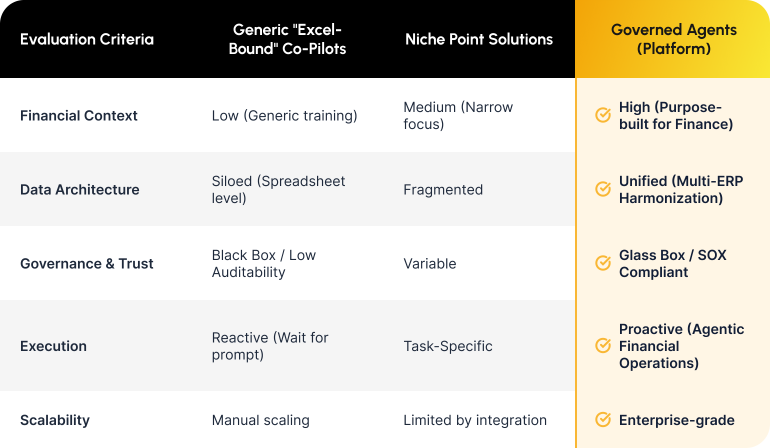
The future of finance goes beyond co-pilots that simply answer questions. The industry is shifting toward Agentic Financial Operations powered by governed AI agents.
Unlike co-pilots, governed agents do not wait for prompts. They proactively and autonomously execute complex, multi-step financial workflows (such as transaction matching, journal entry preparation, and anomaly detection) within strict, user-defined guardrails.
The BlackLine Advantage
This is where purpose-built solutions shine. Platform solutions like BlackLine Verity AI power governed agents that operate within a secure close environment.
Real-World Impact
Transitioning to Agentic Financial Operations delivers clear operational advantages:
Operations Scaling: Process growing transaction volumes and scale operations without needing to add manual headcount.
Accuracy: Eliminate human transposition and manual matching errors.
Higher Value Work: Shift your finance team's focus from manual data preparation to strategic analysis and risk mitigation.
As a finance leader, the choices you make today will define your organization's operational efficiency and compliance posture. The architecture housing your AI is just as critical as the AI model itself. The future belongs to finance teams that deploy trusted, governed AI platforms rather than settling for generic co-pilot shortcuts.
Request a Custom AI Assessment to see how a purpose-built, governed platform can securely and compliantly scale your finance operations.