How to Transform Collections from a Cost Center into a Cash Flow Engine
This guide introduces a new playbook for collections, now powered by AI, so teams can move beyond inefficient, manual processes that trap cash and burn out talented teams. It details a definitive framework that combines a multi-dimensional customer strategy with an "Automate, Assist, Human" model to optimize your capital, empower your team, and transform your collections function into a strategic business victory.


Table of Contents
- Executive Summary
- The Human Capacity Trap
- The Blueprint for a Breakthrough
- The Breakthrough Engine
- How to Maximize the Return on Your Transformation
Share this Ebook


Most collections processes rely on simplistic, one-dimensional prioritization where teams chase the highest dollar value, tackle the oldest invoices, or simply work through an alphabetical list. The critical flaw in this approach is that if you’re trying to deploy an AI solution on top of it, you don’t create new intelligence. Instead, it only creates a slightly more efficient version of an ineffective process.
The real breakthrough comes when you stop thinking about AI as just an automation tool and start
using it as a strategic resource. It begins by understanding your customers from a multi-dimensional standpoint, so you can look beyond simple metrics to see the complete picture of risk, value,
and behavior.
This understanding of your customer process allows you to build an intelligent collections strategy.
One that gives you a framework to answer the most critical questions: “Where can AI automate and scale what was previously impossible?” “Where can AI assist my team to make them more effective?” And, most importantly, “Where must my human experts focus their time for the highest-value impact?”
Achieving this requires more than just technology, it requires a new playbook. This Whitepaper introduces the definitive framework for modern collections, built on a powerful partnership
designed to optimize your entire investment of capital, time, and talent.
BlackLine’s industry-leading AI powered platform provides the automation and predictive power.
Genpact’s deep process expertise designs the intelligent strategy that enables the technology to deliver maximum return.
The combination of Technology + Expertise is how you transform a software purchase into a strategic business victory.

The Human Capacity Trap: Why Traditional Collections Can't Win
For decades, the core challenge in collections has been framed as an issue of effort, design, and discipline. The reality is far more fundamental: it is a structural problem of human capacity versus overwhelming scale. With studies showing that nearly half (55%) of all B2B invoices in the U.S. are paid past their due date (Source: Atradius Group) clear that even the most diligent team is fighting a battle against scale that manual effort alone cannot win.
This overwhelming volume forces teams into a corner where a well-documented pattern of organizational behavior emerges: the Pareto Principle, or the 80/20 rule. This isn't a failure of strategy, but a natural human response to cognitive overload. When faced with an unmanageable number of tasks and limited time, teams instinctively triage their efforts, focusing on what they perceive to be the most critical inputs. In this case, it’s the top 20% of accounts with the largest outstanding balances.
This phenomenon reflects a well-known principle in business strategy. As noted by G2 Crowd, high-performing organizations master strategic focus on the 'vital few' activities. However, in collections, resource constraints force this approach as a survival mechanism rather than a strategic choice, leaving lower-value accounts persistently unaddressed.
While rational, this survival tactic creates a dangerous and expensive blind spot. The "long tail"—
the other 80% of customers, often with smaller but numerous invoices, goes largely neglected.
This represents a massive pool of trapped working capital that and unmanaged risk that not only
grows daily but goes ignored for an extended (sometimes even indefinite) period of time.
This isn't just an operational inefficiency, it’s a significant leak in one of your company's biggest investments: your people. The time of skilled finance professionals is squandered on low-value, repetitive tasks. According to research by McKinsey & Company, data collection and data processing are two of the most time-consuming activities in finance. Their analysis concludes that up to 72% of that time can be freed up through automation. When the majority of a skilled employee's day is spent on tasks that a machine could perform, the impact is twofold.
First, it creates a direct and unnecessary drain on payroll. Second, and perhaps worse, it leads to disengagement and burnout, as talented individuals are prevented from applying their skills to higher-value strategic work. This human capacity trap is a dual threat that suppresses cash flow hamstringing business growth while simultaneously eroding your most valuable talent.
The Blueprint for a Breakthrough:
The "Automate / Assist / Human" Framework
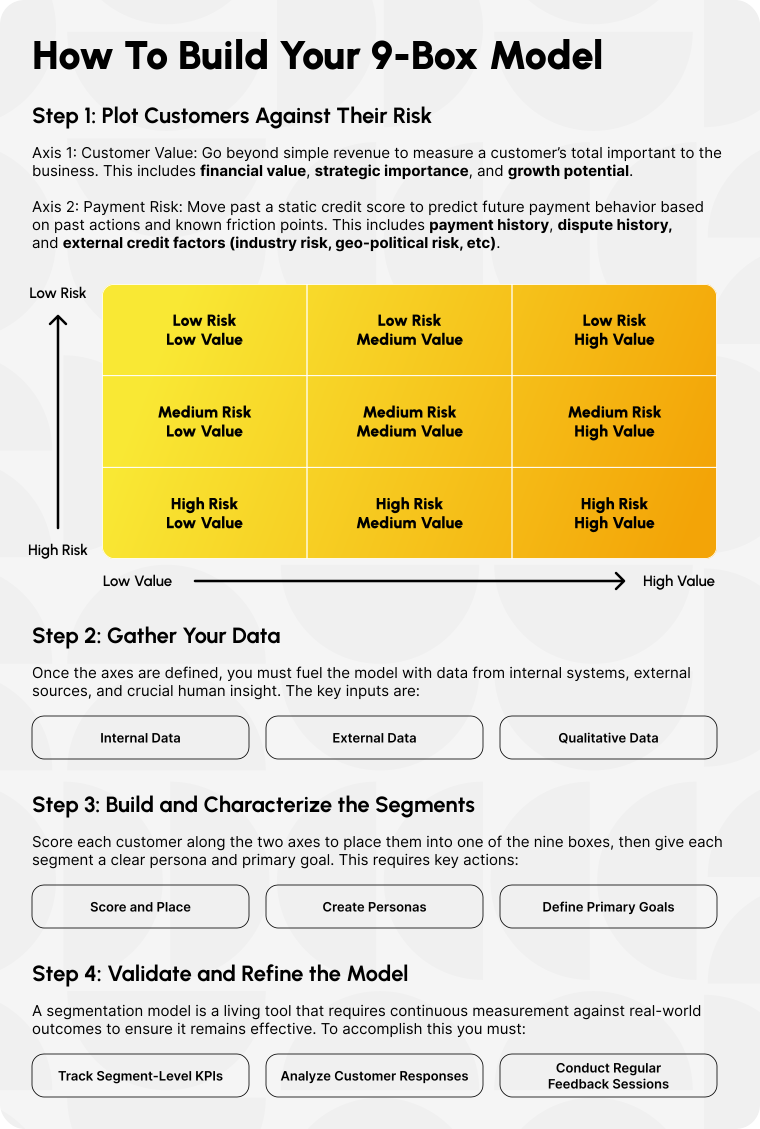
A breakthrough requires moving beyond the one-dimensional, "biggest-first" approach to a multi-dimensional strategy that intelligently allocates resources. The foundation of this strategy is a simple but powerful 9-box segmentation model, which plots every customer based on two key axes: their strategic value to the business, and their real-world payment risk. (Learn how to build one in our breakout graphic below)
Genpact Insight:
Are You Using the Right Data?
“Our experience across hundreds of clients reveals a crucial truth: segmentation fails when it relies on static data. We’ve found that dynamic, behavioral data points—such as 'days to pay vs. terms,' 'short-pay frequency,' or 'dispute reason codes'—are far more predictive of future payment behavior than a generic credit score. Your highest-revenue customer might actually not be your riskiest from a cash flow perspective.”

This model serves as the blueprint for the "Automate / Assist / Human" framework, a sophisticated strategy that applies the right level of intervention to each customer segment. It’s a playbook that acknowledges that a one-size-fits-all approach is a recipe for failure.
The framework operates on three distinct levels of intervention:
Automate
This pillar is designed to conquer the "long tail." It applies touch-less, scalable collections to the high-volume, low-complexity accounts where human intervention provides minimal return. For a low-value customer with a history of on-time payments or even slightly delayed payments, a series of automated reminders is not only more efficient, but it’s also the appropriate level of engagement.Assist
This pillar is for the crucial middle ground where human judgment is valuable but needs to be amplified by technology. AI acts as a "co-pilot," analyzing data to guide the team's efforts. It might generate a prioritized call list based on a customer's changing risk profile or use sentiment analysis to flag a seemingly routine email exchange that requires a manager’s attention. This allows a single collector to manage a larger, more complex portfolio with greater effectiveness.Human
This pillar reserves your most valuable and versatile resources, your team, for your most valuable accounts. For high-value, high-risk customers, a personal relationship is paramount. The goal here is not automation alone, but empowerment. There’s AI that provides the human collector with a complete, 360-degree view of the relationship, given the tools they need to have an informed, strategic conversation that preserves the partnership while securing payment.
This model represents the ideal collections strategy. But it also makes the capacity trap even more apparent. How could a team, already struggling to keep up, possibly manage nine distinct strategies across thousands of customers in real-time? They can't. Not alone.
Genpact Insight:
The "80/15/5" Rule for Intervention
“A world-class Invoice to Cash function doesn't aim for total automation; it aims for optimized intervention. Based on our benchmarks, the ideal balance is often an 80/15/5 model: 80% of invoice volume is managed via touch-less automation, 15% requires AI-assisted human review, and the top 5% of strategic accounts receive dedicated, human-led relationship management. This helps your most valuable resource, your people, to stay focused on the most valuable work."

The Breakthrough Engine: AI-Powered Automation Meets Process Expertise
The barrier to executing a perfect collections strategy isn't a lack of vision; it's a lack of bandwidth. This is the precise point where AI-powered automation moves from a "nice-to-have" to the essential engine of success. This is the "Power of Two" in action: BlackLine's platform serves as the AI engine that makes the strategy possible, while Genpact serves as the expert partner who designs and refines the strategy to ensure help the engine runs at peak performance.
Genpact Insight:
Technology Doesn't Fix a Broken Process
"A common misconception is that AI alone can fix a broken collections process. In reality, it only makes the breaks happen faster. Our first step in any transformation is to use the initial data analysis to identify and help redesign the upstream processes, like inaccurate invoicing or flawed master data for example, that cause payment delays. You must earn the right to automate by first checking the process is sound.”
BlackLine’s Invoice-to-Cash solution provides the technological muscle to execute the "Automate / Assist / Human" framework at scale, integrating with your existing ERP to create a single source of truth. From cash application, to intelligent collections, to a best-in-class EIPP offering, BlackLine is the ideal solution for multinational organizations.
A prime example of this is BlackLine Verity™ Collect, a suite of AI-powered tools designed to execute this strategy with precision.
For the “Automate” pillar, the Verity Collect Call Agent acts as a tireless digital collector. It can make thousands of routine follow-up calls to your low-value accounts that your team simply doesn't have the capacity to handle, turning a low-yield activity into an effective, automated collections process. It holds natural conversations, handles common customer questions in multiple languages, and works 24/7 to ensure no invoice in the long tail is ever neglected.
However, its power extends far beyond just making the call. This is where it truly enables the “Assist” pillar, acting as an intelligent co-pilot for your team. When the Call Agent completes a conversation, Verity Collect instantly transcribes the call and uses AI to extract critical insights, such as a specific promise-to-pay date, the reason for a dispute, or a request for a copy of an invoice.
It then translates this intelligence into a neatly summarized task that appears directly in a collector’s work queue. Instead of manually listening to a call and taking notes, the collector is presented with a clear, so the team can take an actionable directive. “Customer promised payment of $5,804 on Oct 15th.” or “Customer disputes invoice #123 due to incorrect PO. Initiate”’
Now your team has the data to adjust collection strategies, and execute precise follow-ups in seconds, not minutes on only the items that need follow up.
Finally, this creates a handoff to the “Human” pillar. When your collection team engages with a high-value account, they do so armed with a perfect, AI-summarized history of every commitment and interaction. They don't waste time on manual note-taking or tracking; they can have a more strategic, informed conversation.
The business impact is threefold: you reduce manual work by automating routine outreach, accelerate cash flow through intelligent and consistent follow-up, and control your process by freeing your experts to focus on the complex, high-value accounts where they create the most value.
However, the engine is only as good as the blueprint it follows. Genpact's role is to provide the strategic intelligence that directs the engine. This involves not only designing the initial segmentation models but also using the ongoing data from BlackLine to provide continuous, data-driven recommendations.
From Purchase to Payoff, How to Maximize the Return on Your Transformation
A successful transformation is measured by the sustained value it delivers to the business, not at go live. This requires defining success holistically and building a partnership focused on ensuring helping the return on your investment of time, capital, and talent to continues to grow.
To this, success must be viewed as a multi-layered outcome that must be measured across the organization.
Executive KPIs (The Capital)
For the C-suite, success is measured in improved working capital, a material reduction in Days Sales Outstanding (DSO), reduction in bad debt expense and, most importantly, a marked increase in the predictability of cash flow forecasts. While it should be seen in one, but ideally more than one.Operational KPIs (The Time)
For finance leadership, success is demonstrated by the percentage of manual tasks successfully automated, the team's adherence to the defined collection strategies, and a reduction in the average time to resolve disputes.People KPIs (The Talent)
For the team itself, success is felt in higher job satisfaction, lower employee turnover, and positive feedback from customers who feel their relationship with the company has strengthened.
The Hero's Toolkit
(Justifying the Investment)
Frame the Problem
"Our collections process is constrained by manual capacity, which traps cash in the long tail and misallocates the time of our most skilled people."Present the Solution
"We will adopt a 'Technology + Expertise' model to implement a multi-dimensional collections strategy that optimizes our entire investment."Define the ROI
"Success will be measured by our ability to deliver more predictable working capital to the business and more strategic, high-impact work to our team."
Enabling Value Beyond Go-Live: The journey does not end when the software is implemented. A true partnership establishes a continuous improvement loop. This involves using the rich data generated by BlackLine to provide ongoing strategic recommendations and ensuring your team has the operational readiness (BAU processes) and training to manage the new strategy with confidence long after the initial project is complete.

It's Not Just a Tool, It's a Strategic Victory
For years, people thought of collections as just a reactive team that costs the company money.
But a smarter strategy turns collections into a major advantage.
This isn't about just installing new software; it's about investing in a complete solution that makes your technology work smarter, helps your team focus on what matters, and delivers real, predictable results.
By pairing great AI powered software with the guidance of experienced experts, you can finally solve the problem of having too much manual work for your team. You can turn your collections department into a powerhouse that helps your whole business win.